4

What You Shouldn’t Have to Expect When You’re a Teen…

My daughter is turning 18 in less than a month.  She’s been accepted to a college and can’t wait to start making more decisions for herself and living her own life. I remember when she started Middle School at the ripe old age of 12.  I told her, “Middle School sucks for everyone. Nobody knows what they’re doing and many teenagers are cruel.  It sucked for me.  You just have to figure out how to be successful in school over the next two years so you can go on to high school and then leave there with as many choices as you can have when you graduate. ”

I’m sure I’m not the only one who’s had such a talk with their teen child.

What kind of message is that?  I thought I was protecting her, but I really was setting up an awful expectation.

In the US children are precious and must be protected.  Adults have civil rights and enjoy the full protection of the law. What about the time of life in between?  If you ask most adults to characterize teenhood or adolescence, they’ll likely tell you that it’s awkward, frustrating and confusing.  We tell twelve year olds the same thing, and they enter this phase of their lives with dread and an expectation of suffering and struggle.

Why are we surprised when they stop telling us that they’re having problems? Most of their decisions are seen as having enormous impact on their futures. Every grade they earn, person they date, sports team they make, club they decide to join feels like a life changing event.

Many adults, when asked about what they were like as a teenager, wince and say something like, “Oh God, I was a mess. I had no idea what I was doing. I was awkward and didn’t have a girl/boyfriend and I wouldn’t go back to that time in my life for anything!”  We just seem to exclaim, “Whew!” and then start living our lives in a post-adolescent world and try to ignore or not deal with all the important events that shaped us during that time. A.S. King described adolescence as a kind of “hazing” that has to be survived, and I think that’s tragically accurate.  As with any type of hazing, those going through the process do so in isolation and are expected to prove themselves by surviving horrible conditions. That’s what our teens and young adults go through every day.  This unavoidable lonely struggle is a great myth that is reflected in our Young Adult literature which more often than not, features parents and other adults as mere background figures who have little influence the teen characters’ lives.

There’s a catch 22 here that leads to much more suffering than is necessary.  Teens enter adolescence knowing that suffering and unhappiness is inevitable.  When they encounter difficulty they think that it’s nothing exceptional and is just what is to be expected, so they don’t even report it.  It’s not newsworthy. It happens to everyone.  As adults (parents, teachers, family members, or potential allies), we let ourselves off the hook at the same time.  If the suffering is unavoidable, what can we do about it?  We can help them to get help once they’re adults.

Adolescence shouldn’t be equated with suffering.  Yes, it’s a time of growth and change and of figuring out your identity and where you fit in the world, but I feel like my whole life could be described that way!  We need to rethink our cultural view of teen development and not view it as an inevitable and “untreatable” disease or stage that must be merely survived and give our teens hope that they can thrive through their teen years on their way to becoming amazing adults.

My two sons are entering this stage in their lives.  I will tell them something very different from what I told my daughter.  Being a teen is exciting and can be confusing.  It’s a time to be patient with yourself and with your peers as you learn how to make your way through school and to your first steps into adulthood.  No mistake you make will ruin your life forever.  I will be here to listen and to help you as much as I can. If you have a problem, we can work it out together and get help when you need it.  You are a fantastic person and are only getting better.

4

We are Hippodilly Circus. We speak to (not at) the teens.

In the last few weeks there has been a great kerfuffle on the internet about sexism and diversity in YA books. I don’t have anything to add to the conversation, nor do I have any interest in reviving it. The “discourse” got contentious and accusatory and ugly and I am not sure what was accomplished. In the end, many were invoking the way things are or how they should be in the “YA Community.”

I read a lot of the back and forth. I’m not sure what the outcome of the outrage or the vitriol is or will be. I do know that it didn’t ever feel like a discussion, but a shouting match, as is often the case on the internet. I also have no idea what anyone meant by the “YA Community.” I don’t know who is a member of this “YA Community,” but I do know that there is one thing missing from the conversation and from this “YA Community.”

Young Adults.

I didn’t see any actual Young Adults speaking or even invited to the conversation. All I saw or heard were adults in blogging, publishing, and authors themselves telling each other what is wrong with the “YA Community.” Another group of adults telling teenagers what they need and what they like and how they are.

So, while this “YA Community” of adults is busy demonizing each other and launching accusations about what someone’s motives might be and how diversity isn’t being fully embraced, think about this.

Your ageism is showing.

Teenagers are people. They’re just young. They read, think and make their own decisions. If we can’t model an actual discussion, this “YA Community” isn’t good for much. If the teens aren’t a part of the conversation and instead are talked about as if they have nothing to contribute, then we’re just as guilty of discriminating as anybody out there pushing “boy books” or “girl books” or not promoting publishing and writing by people of color or about people of color. If I want to know what the “YA Community” thinks or feels about the diverse books written, published and marketed to them, I ask my students, kids and kids’ friends. They are the Young Adult Community and they should be consulted and heard.

That’s why I started this blog. My hope is that all voices, especially teen voices will find a place here and that real dicussions will  take place. There are plenty of places where teens are condescended to or told what’s good for them. This isn’t one of them.

We are the Hippodilly Circus and we speak to the teens.

1

NOVA Teen Book Fest 2015

The 2nd Annual NOVA Teen Book Fest happened yesterday, March 7 at the Washington and Lee High School in Arlington, VA.  I can’t remember how I heard about it, but I was thrilled that there was a festival dedicated to Teens and YA and that it would be held in my neck of the woods.  My attendance ended up being limited because my family and I couldn’t get our plans for the day quite together and I ended up arriving a few minutes after 2, so I missed the last round of small panels, so I shopped for books, of course and waited for the keynote address.

Books bought:

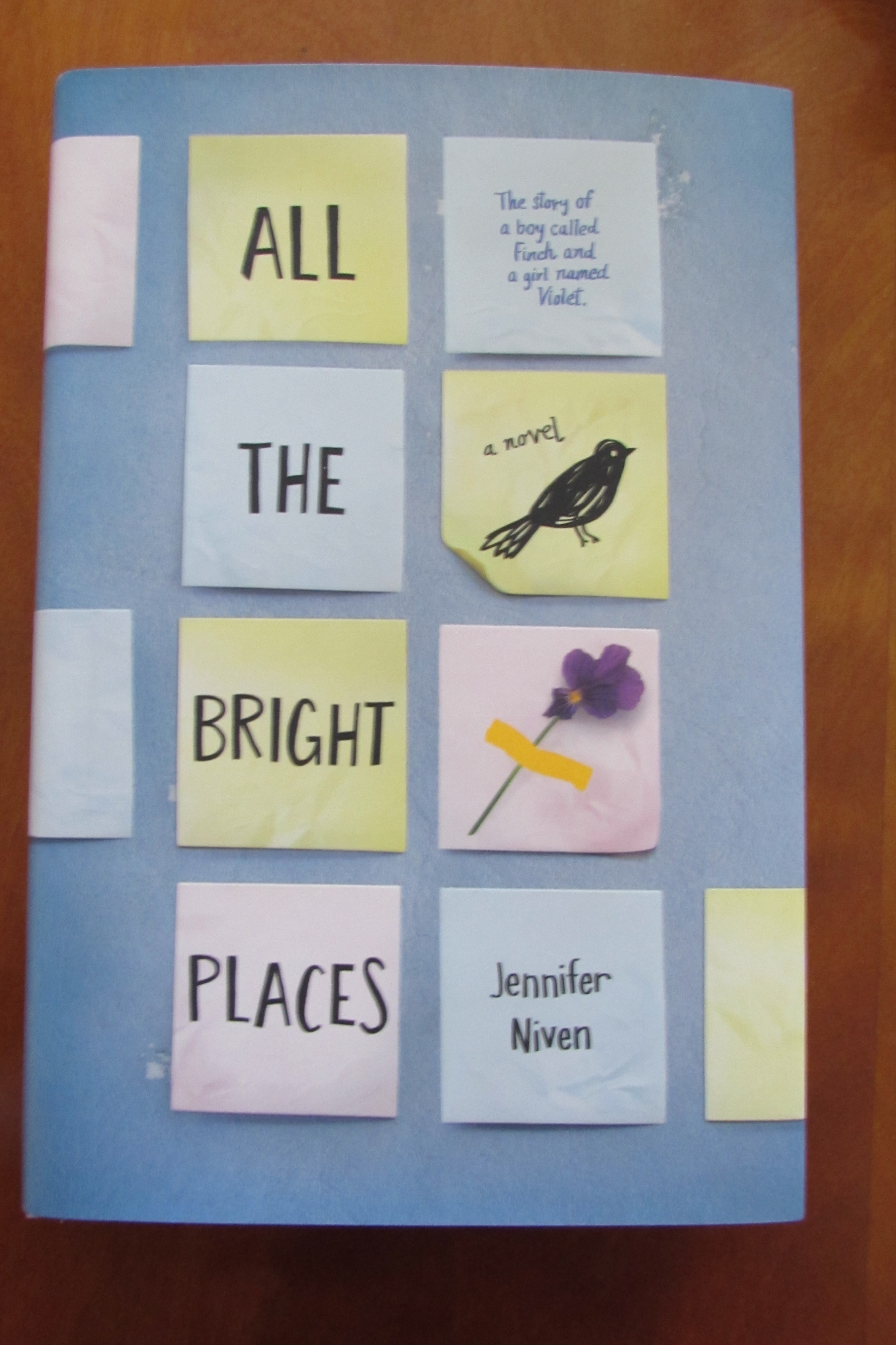
All the Bright Places - Cover

All the Bright Places by Jennifer Niven has a fantastic cover and is a book I have been hearing a lot about.  It’s already been sold to become a movie, so we all need to read it before the filmmakers interpret the story for us. I just read who is going to star in it and I’m not going to share it here, because I hate having an image of a character when I read a book. What the character looks like and is like is something worked out between me and the author, damnit.  I’m also annoyed that I just read that it’s described as “mega popular YA book X” meets “mega popular YA book X” because I’ve already read those books, so I am hopeful that this is a new and unique story not a mash up of already written books.  Jennifer Niven was at the NOVA Teen Book Festival and she was charming and took time to speak to dozens of teens who were getting their books signed. This one is absolutely on my list to read. I am going to take it to school tomorrow and give it to one of my voracious readers so I can hear what she thinks of it.  I have so many books on my to read list that I can’t leave this one around unread. It’s a strategy I use often with books I collect. I announce to my students, “I need somebody to read this for me to tell me how good it is!”  It’s a great way to get books read and they get to be my reviewers. They’re brutally honest and they know that I respect and want their feedback.

I also bought:

IMG_0357

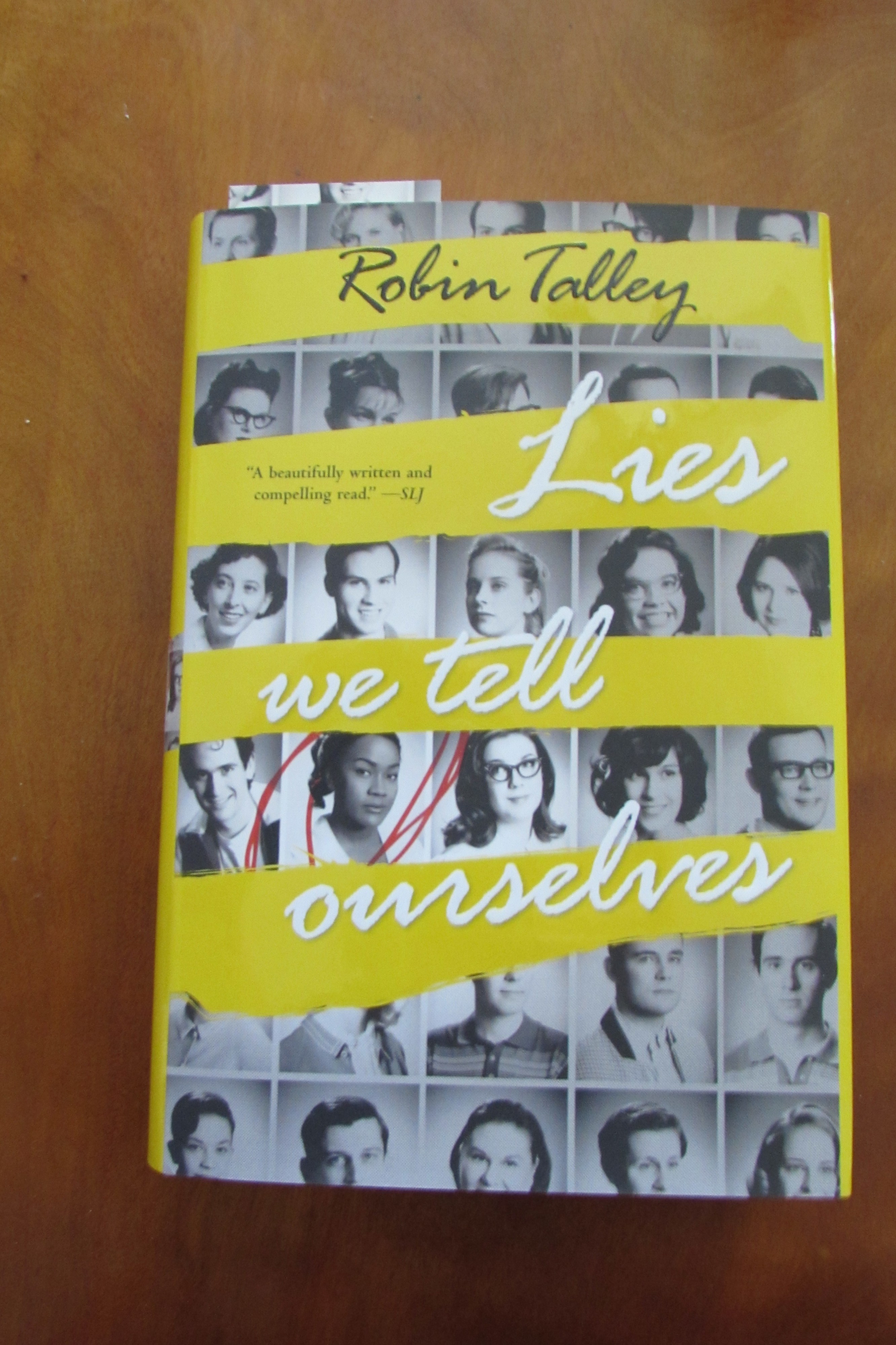
Lies We Tell Ourselves by Robin Talley. It’s so hard to just scan over book covers and then make a decision.  Because I am not up to date on fantasy YA, I was shopping in mostly the realistic fiction books.  This one has an intriguing cover and a local Virginia author!  I thought it was a particularly great story to be presenting on the 50th Anniversary of the March in Selma, because it tells a story about a civil rights pioneer.

From the inside flap description – which sold me:

“In 1959 Virginia, the lives of two girls on opposite sides of the battle for civil rights will be changed forever.

Sarah Dunbar is one of the first black students to attend the previously all-white Jefferson High School. An honors student at her old school, she is put into remedial classes, spit on and tormented daily.

Linda Hairston is the daughter of one of the town’s most vocal opponents of school integration. She has been taught all her life that the races should be kept “separate but equal.”

Forced to work together on a school project, Sarah and Linda must confront harsh truths about race, power and how they really feel about one another.

Boldly realistic and emotionally compelling, Lies We Tell Ourselves is a brave and stunning novel about finding truth amid the lies, and finding your voice even when others are determined to silence it.”

Teens need as many stories of the dangers and personal impact of racism as they can get.  I can’t wait to share this book with my students and my own children.  When I spoke to the author Robin Talley when she signed my copy, we discussed how so many students don’t fully appreciate the cruelty of institutional racism and how it affected so many children’s and teen’s daily lives. I am eager to read this.

Boy in the Black Suitt

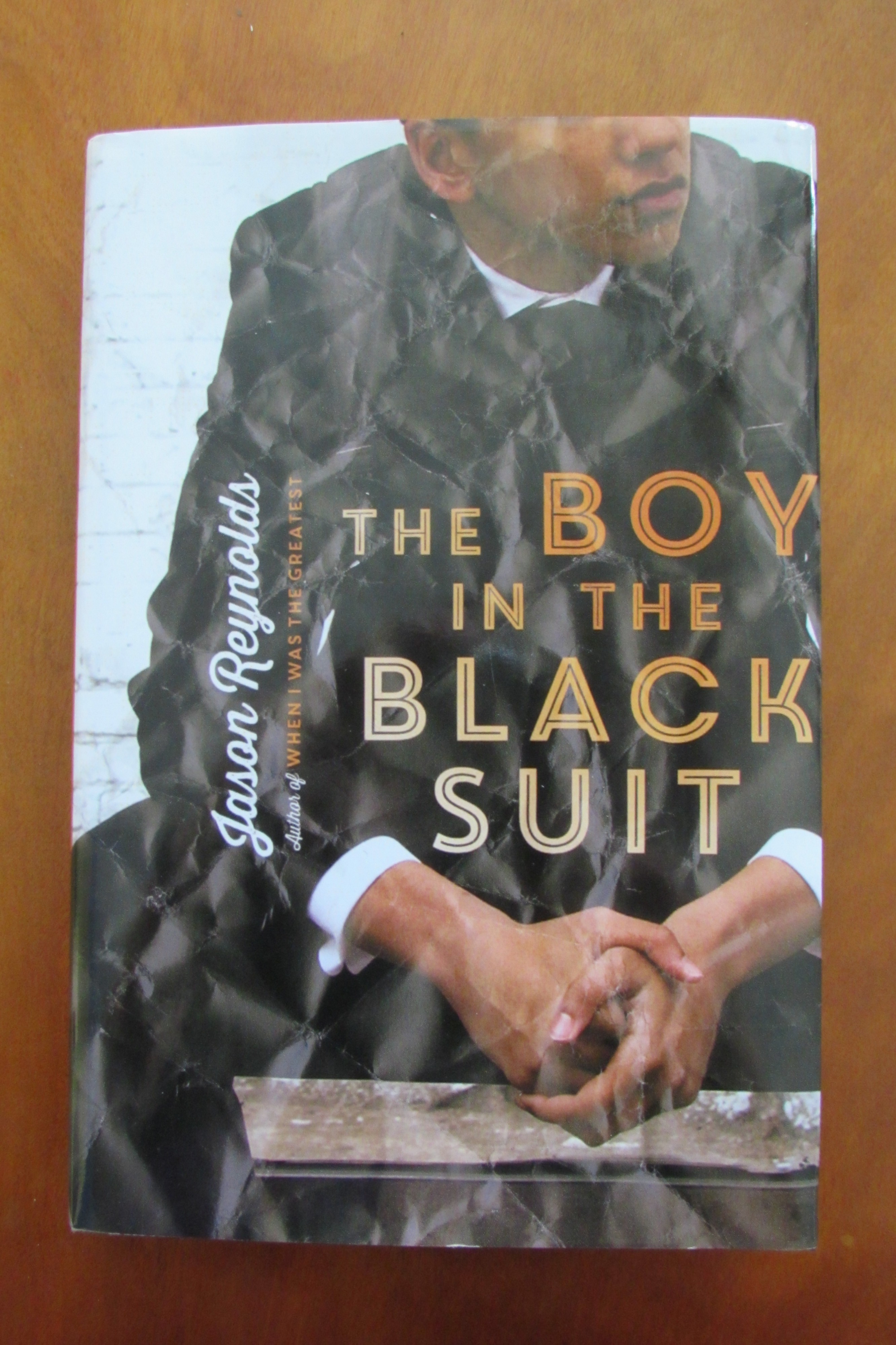
The Boy in the Black Suit by Jason Reynolds. I am a huge Jason Reynolds fan. Huge.  I only learned about him at the National Conference of Teachers of English last November. He was one of the many authors who came to the exhibit hall to sign copies of his books and to talk to teachers. I’ll be honest here. I stopped because he looked unlike any other author I’ve ever seen. He’s young, tall, has long big dreadlocks and dark skin.  I knew that I had students who would be attracted to his books because he looks so different from many of the other authors they’ve encountered.  I got in line and then had to decide which of his books I wanted to receive and have him sign. I chose his first book, When I Was the Greatest primarily because it has an image of a gun covered in colorful crochet on the cover.  I knit and crochet a lot and I love bright “circus horse” colors.  So it was a love match.  One of the characters in the book is a young man who has Tourette’s Syndrome and knitting helps him to control his verbal and physical tics. I asked Jason who in his family knits and he said that he did!  He learned to knit because he could never find a hat that was big enough to fit over his head and hair.  I read When I Was the Greatest and I absolutely loved it. I recently bought his new book The Boy in the Black Suit about a young man whose mother dies. Afterward he wears the same black suit that he wore to her funeral every day. His friends don’t understand his wardrobe, but he’s been hired at the funeral home that handled his mother’s burial.  The funeral home pays much more than the fast food jobs that he could get and he’s working to help pay the bills that his father is unable to pay.  Teen boys who feel rushed to become men seems to be a theme that Jason Reynolds explores. I am looking forward to finally reading this one.

I also recommend Jason’s book My Name is Jason. Mine Too.: Our Story. Our Way co-authored by Jason Griffin. It’s a magical book of Jason Reynold’s poetry and Jason Griffin’s paintings. I bought it and shared it with my students who absolutely love it. It’s one of those books that you have to turn around to read the words or to look at the images and tells the stories of both artists working to become “legitimate” artists in Brooklyn, NY.  It’s a little hard to find, but it’s just magical.

So all of these magnificent people were at the NOVA Teen Book Festival along with many others.  Here’s the Book Fest’s official page on Tumblr where you can find the full list of authors and the program details. http://novateenbookfestival.tumblr.com/ I can’t wait to go back next year and I will definitely be volunteering.

I got to the festival in time for Matt De La Peña’s amazing Key Note Address. I love Matt’s books.  He’s a vocal advocate for the ‘We Need Diverse Books’ campaign and is a wonderful writer of books about Hispanic Americans – especially boys.  Because I teach so many students from Central America and so many boys, I have recommended Matt’s books to them as stories about kids like them.  Matt’s address was a series of humble and hilarious stories about his journey to become a published writer.  I hope that someone videotaped it and will post it on youtube. It was fantastic.

He spoke about the young men he sees when he visits high schools. He said that he can see so many of them putting up a wall or a front of toughness that protects their reputation and their hearts as they navigate becoming men. He said that he wants to tell them:

“Books can become your secret place to feel and nobody has to know about it.” 

That is something that I will take back to school with me and it will become a writing prompt for my students. It’s so deeply true.  I have said for several years that books are often the only therapy that many teens and young adults will ever get and with authors like Matt De La Peña and the other authors who came to the NOVA Book Fest to connect with their enthusiastic readers and fans who have been moved by their writing, they will get the understanding and the emotional outlet they need in a safe place that nobody has to know about.

Thank you NOVA Teen Book Fest and I’ll see you next year!

 NOVA Teen Book Fest 2015

1

Freedom of Expression – Just Not at School

One of the problems with being a teen and a student is that your freedom is so limited, if you have any at all.  So many writers, musicians and filmmakers talk about the journals they kept as teens and how they kept them for ages before sharing them with the world.  Traditional publishing was inaccessible to teenagers and few had a way to find an audience for their message or their art outside of the restrictive world of their school.

I remember distinctly the Hazelwood School District et al. v. Kuhlmeier et al. Supreme Court case in 1988.  The basics of the decision were that school newspapers were not forums for student expression and therefore, students did not have the right to free speech.  Their “speech” could be censored legally by school officials. I was on my high school newspaper staff in 1988 and I was outraged. Like most 17 year olds, moral outrage was one of my best skills.  I attended a student journalist conference in Washington DC that summer and got together with students from many different states and we all wallowed in our collective outrage. Seventeen is the precipice of freedom. I was headed to college the next fall and I was ready to make my own decisions. Saying what you think and exposing injustices was exactly what a student run school newspaper was for and now the nine old people in the Supreme Court had told us officially that we had no right to say what we thought.  Outrage on top of outrage was the result.  Outrage and gnashing of teeth, but no action. It was frustrating and left us all feeling helpless and impotent.  We just had to wait a year or two until we magically became adults and could say what we wanted.

As a teacher, I see all the restrictions that are placed on schools in attempting to “guide” students. Another list of “don’ts” for the young people!  The message is, “We want you to become productive citizens who are able to think critically, as long as you do it through an approved format within these restrictive formats on only these topics. Oh, and if you could do it in a horrifyingly boring five paragraph essay, that would be great.” I don’t know where these rules originate.  How is it we’re surprised that teens don’t feel confident enough to express themselves creatively, forcefully or thoughtfully?

All this is thankfully counterbalanced by brilliant, thoughtful and daring teens who are expressing themselves through the freedom that exists outside of school through the magic of the internet.  Their ability to craft a message to their peers and the world is noteworthy because it reaches a broad audience outside of school.  My favorite example of such a person is Nathan Zelalem.  I’ve followed Nathan for almost four years now through his youtube channel ‘The Third Pew.’  He’s my second favorite member of the Zelalem family. His sister Salem is my Young Adult reading guide and great friend. She is the greatest.  Nathan’s videos are funny, thoughtful and well crafted. They are also messages that would get made within a school.  No teacher, club sponsor or principal that I know of would facilitate or encourage the freedom that Nathan’s parents have given him. While it’s disappointing to think that school is so restrictive, it’s also thrilling to think that there are teens like Nathan out there saying what they want to say the way they want to say without the restrictions of a classroom.

Here’s one of my favorite of Nathan’s videos:

There are teens out there speaking the truth, kicking butt and making the world better.  We need to keep looking for them and encouraging them to speak out. With the standardization of testing and testing and testing permeating all parts of students’ lives, those who have the guts and the work ethic to speak out need our support and encouragement if they’re going to survive and having the courage to say what they think without restrictions from adults. Team truth!

10

Kids, school is not real life…

Middle School and High School – just the mention of either institution is enough to bring on post-traumatic feelings for so many people.  The inescapable nature of the building itself, the fear of choosing the wrong outfit/hair/music or even the wrong lunch table is overwhelming and omnipresent.  Of course there are pressures and problems for students that make school stress even worse.

Now that I teach Middle School students, I see the pain, frustration, and confusion in their lives first hand.  Many of the students I have taught also bring enormous pain and damage from lives of poverty, abuse, and loneliness.  Since I teach remedial reading, these same teens are also facing years of failing scores on their SOL tests (Yes that’s the actual acronym for Virginia’s end of year high stakes tests).  When they reach my classroom, they bring that whole history of personal frustration and school failure that has grown in them to a full blooming sense of inevitable failure. Every time they’ve tried, they’ve failed, according to the state – for years. How can a teacher convince them otherwise? I struggle with it every day.

When these Middle School students run into mean girls, bullies, or teachers who are cruel and controlling it adds to their feeling that they can’t control their lives and they lose hope that they’ll ever be able to make their own decisions. They are convinced by the lessons of their own history that they’ll always be at the mercy of someone else, unable to escape, succeed or get what they want.

This is what I tell them when they feel that life will always be like it is at school: School is an artificial world and is different than what their “real lives” outside of school will be like. At school, they have very little choice. They can’t choose to avoid people who are in their classes or the teachers who make them feel inferior. I tell them that in my life, “You know what I do when I meet someone I don’t like? I do my best to NEVER see them. I stop going to that store, change jobs, or I could even move to a new city if it got bad enough.”  I can choose whom I sit next to, whom I work with on many projects and whom I spend my free time with on the weekends.  Some of them get quite literally wide eyed at this declaration. They don’t really think about the choices they’ll have and are usually stunned that an adult, a teacher even, would tell them that school isn’t fair and it’s not the same as real life.

I wish someone had told me these things when I was in eighth grade.  I attended Middle School a few miles from the Middle School where I teach now. I was miserable. I played french horn in the band and had some friends, but I was depressed. I hadn’t experienced any of the traumatic events that some of my students have, but I was frustrated and sad every day. The advice I received at home was to tough it out and make the best of it, as my mom was in the midst of a major depression herself and my dad worked twelve hour days and traveled frequently.

It was lonely. I had moved to the area in third grade and never felt like I found my place. I always felt that everyone else knew what they were doing – not me.

Would I have believed it if someone had told me that what I was going through was not “real life?”  I’ll never know. I do know that it has helped my students to know that they are stuck in an artificial world where they have little control, that it won’t last forever, and that it simply must be endured. All adults have lived through it and for nearly all of us – it sucked. They are not alone. I understand and I remember.

Of course, books help. For me, it was Agatha Christie books.  The order, predictability and the sure success of figuring out the murder in mystery books was always satisfying and gave me a feeling of some control. I read them all. I read them through the horrible home perms, the braces, the friends who didn’t invite me, my mom not getting out of bed for days with a headache, through everything. They reassured me that problems could be solved.

Books help my students, too. Any encounter with a character who struggles with school and it’s artificial world and then endures – helps. It gives them hope and it also gives them the gift of another human in the world who says what no other adult has said to them, “I have been there and I understand.” That gift of understanding and recognition is precious and soul saving.  Reading saves. Young adult fiction saves.

I would love to hear you thoughts. Please leave a comment.

Christine

2

Telling the truth is a two way street

I teach struggling Middle School readers. They are between the ages of 12 and 14. Many of them come from homes full of stress – emotional and financial.  Some don’t eat enough. Some of them are abused constantly at home.  Some of them don’t have a conversation with any adult outside of our school building. Their parents work multiple jobs, they’re alcoholics, they’re mentally ill, they don’t have the emotional energy to speak to them.  The reason doesn’t matter. Students come to school desperate for someone to listen and to feel safe, and if they don’t – they can’t learn or connect.

My students have experienced huge and real things in their lives. I don’t know how to process many of the disturbing secrets that they tell me about the horrors of their lives.  It feels completely insane for me to say that it’s hard for me to process the idea of what these kids are actually experiencing. How do they “process” it?  I don’t think I knew what the act of “rape” was when I was 13.  My students have told me stories about rapes and about being hit and about alcoholic fathers.  They live in fear of the INS, of CPS and of not ever meeting the siblings that their parents left behind in their country.  I’m not sure I could deal with those kinds of problems as a 43 year old woman, so how they are supposed to get up every morning and care about their homework when they are dealing with figuring out how to get through a day with out food?  I don’t know.  I really don’t know.

Here’s what I do know.  Telling me their stories is the bravest thing I’ve ever seen. Exposing their pain and revealing the horror of their lives to me is a gift. It’s a sacred moment. Reacting to their confessions is the most important thing I do in a day of teaching.  I can’t transform their lives into lives of comfort and safety and love the way I would like to – the way they deserve. I can’t bring them all home with me, which I would like to do often.  I can only listen. I can let them know that there’s one adult in this whole world who thinks that what is happening to them is wrong and should have never happened.  I can let them know that my only concern is that they are OK. That they are safe. That my door is open and I will listen and hear them any time they need me to.  I can let them know that I love and respect them – no matter what their grades are. The moment of connection when I can look them in the eyes and say, “I am so sorry that happened to you,” is one that I am so grateful to have.

So, when people out there say that we need to have “age appropriate” stories in YA, I don’t know what they’re talking about. If I can hand a kid, whose home life is a disaster and whose father drinks until he passes out every night, a copy of “The Absolutely True Diary of a Part Time Indian” so that he can see that a kid like him lived through something just like he is going through, it may be the only “therapy” he ever gets. Sexual assault, bullying, violence, abuse, and eating disorders in YA books ain’t going to drive teenagers to any emotional or mental health crisis.  If they’re on the verge of a crisis, they won’t finish the book. If they’re suffering, a story told with respect for the characters and their struggles is a balm that can soothe a student’s suffering. Every time they recognize their own pain in the safe world of fiction, they make another critical connection in the world that says, “See? We’ve been there, too. It sucks, doesn’t it?” and maybe that means that they can get up the next morning and try again. If they feel a little bit less alone in the world, then I have given them truth in return for their trust and confessions. That’s what I do.

Kids need to read more books about real issues like racism, abuse, bullying, and homelessness, not fewer. They need to know they’re not alone. I am privileged enough to hear my students in person.  They are lucky enough to find their own lives in the books we read.

0

New Year, New Books!

On the evening of the first day of 2015…

I got books for Christmas this year. I hope that you got books, too. I actually didn’t get any books that I had asked for, but that’s probably because I didn’t ask for any books specifically. I didn’t ask for any titles in particular because I have a huge backlog of books to read. At NCTE I picked up many books and haven’t read nearly as many as I would have liked by now.  However, my family did a great job of picking up some beautiful books for me.

*The following photos and summaries are from Goodreads*

1) Adam by Ariel Schrag

Adam

“When Adam Freedman — a skinny, awkward, inexperienced teenager from Piedmont, California — goes to stay with his older sister Casey in New York City, he is hopeful that his life is about to change. And it sure does.

It is the Summer of 2006. Gay marriage and transgender rights are in the air, and Casey has thrust herself into a wild lesbian subculture. Soon Adam is tagging along to underground clubs, where there are hot older women everywhere he turns. It takes some time for him to realize that many in this new crowd assume he is trans — a boy who was born a girl. Why else would this baby-faced guy always be around?

Then Adam meets Gillian, the girl of his dreams — but she couldn’t possibly be interested in him. Unless passing as a trans guy might actually work in his favor…

Ariel Schrag’s scathingly funny and poignant debut novel puts a fresh spin on questions of love, attraction, self-definition, and what it takes to be at home in your own skin.”

My son Carl gave me this book and I can’t wait to read it. I have not read her other writing, but the reviews and the subject are definitely of interest to me. LGBTQ YA books are not easy to find and really good ones are even harder to find. I have great hopes for this one. Also, I really love the cover art.

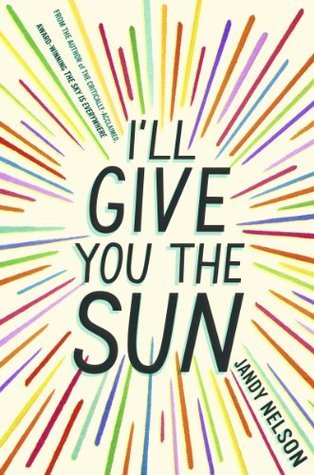
2) I’ll Give You the Sun by Jandy Nelson

I'll Give You the Sun

“Jude and her twin brother, Noah, are incredibly close. At thirteen, isolated Noah draws constantly and is falling in love with the charismatic boy next door, while daredevil Jude cliff-dives and wears red-red lipstick and does the talking for both of them. But three years later, Jude and Noah are barely speaking. Something has happened to wreck the twins in different and dramatic ways . . . until Jude meets a cocky, broken, beautiful boy, as well as someone else—an even more unpredictable new force in her life. The early years are Noah’s story to tell. The later years are Jude’s. What the twins don’t realize is that they each have only half the story, and if they could just find their way back to one another, they’d have a chance to remake their world.
This radiant novel from the acclaimed, award-winning author of The Sky Is Everywhere will leave you breathless and teary and laughing—often all at once.”

Again a brother and sister story and it sounds fantastic. Again an author who is new to me. It would appear that 2015 will be a great reading year for me.

Also, the cover art on these books is brilliant.  They are beautifully simple and compelling. I loathe photographs on the covers of books. I don’t want anybody but the author telling me what the characters look like.  Don’t give me a cover with a photograph of a frilly girl on the cover or a shirtless guy unless you want me to walk right by it. I know that authors don’t have much input on their cover art and that makes me angrier still. Don’t even get me started on the “movie editions” of books. Barf.

At the moment, I am reading ‘All the Light We Cannot See” by Anthony Doerr and am listening to “Unbroken” by Laura Hillenbrand.  I am not madly in love with “All the Light..” yet.  However, it is about 2 young people one of whom is a teenage boy being trained an a Nazi school.  “Unbroken” is so compelling and Louis’ childhood and young adulthood is an amazing story unto itself. Oddly, Edward Hermann, the lead vampire from “Lost Boys,” FDR in “Annie” and actor in zillions of other movies reads the book. He died yesterday.  Of course I didn’t know Mr. Hermann personally, but as a listener to many audiobooks I can tell you that listening to someone reading a book aloud to you is an intimate experience. I’ve spent hours in my car with him talking to me also in my room while I fold laundry and even in the bathtub! I have hours left to spend with him. The experience has made me think of the indestructibility of stories and story tellers. He will go on as will the story he’s telling me as will his film work. The stories live on…

Goodreads wants me to set a number of books to read goal for 2015. I’m not going to do it. I don’t use Goodreads that much and I find that forcing myself to read a certain number of books just makes me frustrated. I am reading more now than I ever have and that’s good enough for me.

What are you planning to read in 2015?

1

In news related to King Dork Approximately…

I purpled my hair, because I like to think that I’m a little bit punk rock from time to time.

/home/wpcom/public_html/wp-content/blogs.dir/c56/80573817/files/2014/12/img_1384.jpg

0

Getting Everything Wrong and Giving No Credit

It’s been a rough couple of days at our house. I won’t get into details, but suffice it to say that I will never understand teachers, guidance counselors, or administrators who seem to derive joy or a perverse charge out of belittling students. There is at least one of these trolls at every school. You know the one who prides herself on making tests that nobody scores higher than 75 on or makes belittling comments just because they have authority in class and because they’re the adult. Why would you use your authority to do that? I don’t know why, but I know that there are too many of them out there. Two of these small minded ogres met with two of my children this week. I suppose that they assumed that my children don’t know that they shouldn’t be treated that way, that they wouldn’t tell me about it, or that my husband and I wouldn’t make our displeasure clear. They were wrong. Nobody of any age deserves to be treated like that. People do it to teenagers because they view them as “less than” full people. The two adults at my kids’ school have been made well aware of their errors. I don’t hold out much hope that they’ll change their ways, but they may be more thoughtful in the future.

Painting youth as less than full people is again a theme in the Washington Post opinion post http://www.washingtonpost.com/posteverything/wp/2014/12/15/why-the-message-of-the-hunger-games-films-is-dangerous  The whole critique smacks of condescension. This paragraph sums up the argument and the tone to me.

“Despite these heady sentiments, the film’s depiction of revolution is astonishingly simple, an adolescent vision of toppling an “evil” authority figure. Sure, this isn’t surprising as it’s meant for young adults, but in the context of political spillover this anti-authoritarian vision becomes more troubling.”

The whole thing makes me seethe.  I haven’t seen the Mockingjay part 1 movie, but I do know that the story of the Hunger Games is not “astonishing simple” by any measure. In the first two films, President Snow is definitely a villain, but he’s not seen as the only problem. Nor do any of the characters indicate that removing him will fix everything. The author in the post tears down a work of fiction adapted into a film, not a political text or a revolutionary handbook. His analysis gets it wrong on every point. 

Things that are meant for young adults aren’t simple. Neither are young adults themselves. When we consistently underestimate young adults, they underestimate themselves and stop taking risks of trying to make a difference and the whole world suffers. Instead of preparing them for making an impact, we tell them they can’t understand the world and that they should wait until they are older.  We pretend that we know what’s best for them and that they don’t know themselves or the world.  What a disservice we do when we tell them they can’t understand and we silence their voices. 

Which brings me to DC by way of Ferguson. At the March for Justice last week, several young adults took to the stage to speak. They had not been invited to speak and they were angry about it. Those of us in the crowd did not know what was going on and the scene seemed showed discord and in-fighting.  To me, it didn’t fit with the day, but I didn’t know what was happening. Now I do.

The full story in their own words can be found here. http://www.ustream.tv/recorded/56473447

Young protesters explained that when they started their protests and making their voices heard in the immediate aftermath of Mike Brown’s shooting death, they faced tear gas and rubber bullets as well as threats and other dangers. They kept protesting and fighting making noise. They thought that they would receive support and training quickly from established civil rights groups like the NAACP and others. They did not. When the established groups arrived in Ferguson, they did not speak to the young people who had been making a difference, they instead held their own events and didn’t invite or include the young protesters. The March in DC was more of the same. Many groups and speakers who have had no involvement in the ongoing dangerous and continuous protests in Ferguson were asked to speak and issued VIP passes. When the young Ferguson protesters arrived at the march, they were denied an opportunity to speak. Again, shut down by the older people who shushed them. They are refusing to be silenced and are continuing to make their voices heard. They stormed the stage and demanded to speak. They were grudgingly allowed to do so.

Young adults who understand their world and who are refusing to accept the status quo. We need more of them to make us all think and to add their voices to the world. Shutting them down is cowardly and wrongheaded. We can do better and if we do, they’ll make our world better.

2

Reading YA to find my tribe…

Like a lot of people I found solace in books growing up.  I try to explain to my students today that when I attended Washington Irving Middle School down the street from the Middle School where I teach today, there really weren’t YA books. That just wasn’t really a thing. They do not get this concept at all or grasp the gravity of what they have access to today. My middle school reading was Judy Blume (Forever terrified me) and Lois Lowry’s A Summer to Die made me sob into my pillow for many nights. I had read all of the Madeline L’Engle that existed and I had loved everything Katherine Patterson wrote. I felt that I had run out of books to read and I didn’t want to go back and read the kid chapter books that were being released.  There weren’t books out there, that I knew about anyway, written about people my age who were going through what I was – even in general – school, romance, puberty and general confusion and angst.

I still read. For me, the intermediate step in reading was the magnificent Agatha Christie. I had read really fun mystery books by E. W. Hildick when I was younger. They now seem to be out of print, which makes me sad. They ignited my love of mysteries.  Instead of neighborhood puzzles of missing bikes and turtles, my new sleuthing turned to murder.

There was very good news for me in Agatha Christie’s books. First of all, there were tons of them to read.  That was important. I needed companionship. Second, the sleuths were weird and didn’t take steps to hide their freaky obsession with crime and murder or their talent in reading people.  Both Miss Marple and Poirot were outsiders who were held in some suspicion whenever they showed up. Another trait they shared was that they listened to no one and followed rules only when they served their purposes.  This disregard for the rules or what has always been done is a part of them that I’ve always loved. They not only didn’t listen to local police officers or anyone else who got in their way, they simply charged ahead without regard for warnings or scoldings to follow procedures.

The books I read as a teenager were decidedly adult. I wasn’t into comic books so much and there just didn’t seem to be much else out there. So, I turned to the books we had to read for school. I was assigned to read three books during the summer before my freshman year of high school.  We moved from Springfield, Virginia to Montgomery, Alabama. In Montgomery, my dad was assigned to attend Air War College with military people from all over the world. My brothers, who were in sixth and first grade, attended the base elementary school.  They were in classes with children from Sweeden, Saudi Arabia, and countries all over the world. In stark contrast, I attended Saint James School. Saint James is a private school. When we moved to Montgomery, my parents were told that the public schools there held dozens of pregnant girls, knife fights in the hallways and all manner of depravity. Of course, these schools were attended by mostly black students, so racist parents had told my parents these fairy tales. Since my mom had a zillion things to consider on the move and since we would only be in Mongomery for a grand total of 11 months, she made the easiest decision and sent me to the school that most other kids on base would attend.

As it turned out, Saint James School that was a dodge for desegregation. Basically, if you could afford to send your white child to Saint James, you could be sure that they would never be forced to encounter a black student, teacher or any black person of any sort. It was horrible.

The reading I had to do that summer was typical for the time, I think. We had to read A Tale of Two Cities by Charles Dickens, Pygmalion by George Bernard Shaw, and Billy Budd by Herman Melville. I spat on the floor when I wrote Billy Budd just now. I have a deep abiding hatred for that book. I think everyone has one of those books that someone tried to make them read that haunts them with its arcane language and stupid characters and insufferable plot. For me, that book is Billy Budd *spit*.  The damned thing is only 116 pages, but I could not force myself to read it. It sucked. I can’t even remember why I hated it so much. I have erased it from my mind and experience. I’ve expunged it from my psyche. I loved the other two books. I really enjoyed reading them. The end of A Tale of Two Cities was so beautifully romantic and tragic. I cried and felt like a better and braver person.  I understood the lessons from both books and hoped to be the type of person who would look beyond beauty and fight for the less fortunate.  Billy Budd could kiss my ass.

I read off and on for years after that. I loved Madame Bovary and The Adventures of Huckleberry Finn.  I found Albert Camus’ The Stranger thought provoking and disturbing. I fought not to run away from home the minute I finished reading On The Road and wished I had friends and a life like Jack Kerouac. I read all of those books that many teenagers dislike reading both then and now. I was a huge literature nerd and went on to study more books and writers in college.

In my late thirties, I was in graduate school when I discovered Young Adult literature. I took a summer class at George Mason University about Multicultural Young Adult Literature. It changed my life and my reading life.

I had an unhappy, if not tragic, adolescence. My parents and I did not get along. I was a great student and I had a group of great, mostly male friends. I loved my teachers and enjoyed myself at Hampton High School.  It was a great school full of amazing people. The school was in my memory about 55% black and 45% white. I don’t remember racial problems. I befriended whomever I wanted to and am friends with many of those same great people today. Being at home was horrible and I was grounded all the time. My mother once threatened me with family therapy and I was so excited that I think I screamed, “Fantastic, when!”  She never made good on that threat. I suffered clinical depression, though nobody knew it then and I still do. I had what can only be described as a major depression/nervous breakdown during my sophomore year in college and took six months off from school. It was tumultuous. I spent the next fifteen years getting my mental health in order, getting married and starting a family.

In that grad school class I found some of the best therapy I could have found. It was amazing. Chris Crutcher’s Staying Fat For Sarah Byrnes changed everything. I had never read anything like it. For those of you who haven’t read it, please stop reading this right now and go find it. NOW.  It’s the story of Eric and Sarah Byrnes. They’re both circus freaks at their school. Eric is fat and everyone calls him Moby. Sarah Byrnes in the cruelest twist of fate has a horribly disfigured face from horrible burns.  Eric has started training on the swim team and is slimming down and becoming less freakish. He and Sarah fear that their friendship won’t survive his change in status and he does his best to stay fat.

It was the first book I had ever read that treated teenagers as full human beings with fully valid feelings, opinions and problems.  The kids in the book were real and genuine and flawed and needed to be listened to. All of them.  Every time somebody reached out, found a way to really get heard, or decided to defy the controlling people in their lives, it felt like a small piece of me was healed. That may sound like too much, but it really is true. Chris Crutcher gets people and he really gets teenagers. They are people. They feel things deeply and need the space to feel, make mistakes and to help each other. Sarah Byrnes and Moby are amazing. There are fantastic well meaning adults, too. Ms. Lemry made me want to go hug a random teenager and make them feel better. I don’t want to give you a plot summary as you can find them in lots of other places. Reading that book was a huge moment and revelation for me. I had always loved teenagers and thought they never got the respect or credit they deserved. Here was someone who felt the same way about Moby and Sarah and about my badly bruised and unheard teen self.

I couldn’t believe it. I met Chris Crutcher unexpectedly at the NCTE conference this year. When I saw him at a session, I knew who he was immediately. I made my way to him and when I got to speak I said, “Thank you so much for Sarah Byrnes,” and immediately burst into tears. I explained that the book was just so important to me and I was just so grateful. When I told my 17 year old daughter the story when I got home, she shook her head and told me that I am, indeed, a mess.  Fortunately, I was able to talk with Mr. Crutcher the next day before a session and apologized for my blubbering and then had a normal tear free conversation with him.

So, that was my introduction into the tribe of what I’ve come to think of as ‘real’ teens in Young Adult fiction. I’ve met many more of them over the years, but Sarah Byrnes and Moby really were the first members of ‘The Tribe’ of weirdos that made me feel less alone. If they could help each other and love each other through their missteps and through the cruelty and judgment that they had each encountered at school and at home, there was hope for so many more of us.